Happy New Year! Reflections on OLPC in 2011

As we prepare for 2012, here is a quick look back at the past year of OLPC. We distributed our two millionth laptop (now 2.5M), and our largest programs in Latin America (Peru) and Africa (Rwanda) grew steadily. Austria’s Julieta Rudich and Journeyman Pictures produced a fine documentary about Plan Ceibal in Uruguay (the world’s first complete olpc program), and Peru provided XOs and compatible robotics kits to all of their urban schools.

In East Africa, we expanded our work with African nations and donors to improve education for children across the continent. We were invited by both the African Union and the UN to open an OLPC office in Addis Ababa, Ethiopia. Addis is a major hub for African diplomacy, and the support there for our mission has been stunning. We have become a full partner of the East African Community in Tanzania, and our recent country report on Rwanda has driven further interest in the region.


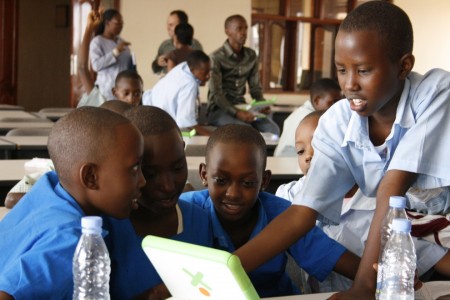
A Rwandan student workshop in Kigali

In the Middle East, we continued working with the Palestinian Authority, Israel and the UN to provide thousands of Palestinian children with XO laptops, integrating them into schools. It took ten months to work the laptops through customs in Gaza. But at a forum in Ramallah in June, teachers from Bethlehem and Gaza showed how OLPC was helping to end isolation and to excite learning for their children. Third grade girls in refugee camps are teaching others and writing computer programs. The testimony of these women to the power of persistence was extraordinary.

In Afghanistan, we founded a regional OLPC Afghanistan office, and briefed General Petraeus on the project. We believe that one laptop per child and connectivity, across the country, will transform this generation and their communities. Today we are working with the Education Ministry to support four thousand children in 10 schools, and are looking into expanding in Herat Province.

On the technical side, we focused on driving down laptop power needs by switching over to ARM chips in the XO-1.75 and upcoming XO-3 tablet. The tablet should be chargable by a solar panel that could serve as its carrying-case. We are studying new ways to help children learn to read, including where there are no schools at all.

In society, the idea that every child should have access to their own computer and to the Web – as a basic part of learning, whatever their family income – continued to spread. In addition to ongoing national programs in Argentina, Portugal, and Venezuela (for secondary students), two full-saturation laptop programs for older students are developing in India – an inexpensive tablet is being distributed to university students, and in Tamil Nadu dual-boot laptops from six different manufacturers are being provided to secondary students.

Reaching the least-developed countries in the world remains our goal and our most difficult challenge. While our largest deployments are funded directly by implementing governments, rural successes may be driven by foundations, NGOs, and individual donations. OLPC Rwanda, today one of the largest educational technology projects in Africa and part of a ten-year government plan, was seeded with ten thousand laptops given by Give One, Get One donors.

So to our supporters: thank you for your development, contributions, and collaboration, your feedback from the field, and your encouragement! This is all possible thanks to you.

Happy New Year to all — may 2012 bring you inspiration and discovery. We have some excellent surprises planned for the new year. And we would love to hear your reflections as well — please share stories from your own school projects in 2011.

Comments (2)

Dr. Sugata Mitra in Montevideo, Uruguay

This essay is reposted by Carlos Rabassa of Uruguay, from a lecture he gave in June.

Dr. Mitra gave an excellent lecture on June 2, 2011 at Universidad ORT in Montevideo, Uruguay on “The Future of Education”.

His first major experiment was the hole in the wall computer, which was later replicated in many locations. They look like the ATM, Automatic Teller Machines, the banks use. They are computers connected to internet, located behind walls. The users have access, from the other side of the wall to the screen, a video camera and a touchpad.

These computers are accessible from streets in neighborhoods where kids had never used a computer. The children are not given any instructions. Researchers collect data for their studies on how the computers are being used.

Dr. Mitra started working in India his birthplace, then in England where he is now based, Newcastle University. He has been traveling and testing his findings all around the world. During the days preceding the lecture he had been working in Uruguayan schools.

He showed us studies made in India and in England. In India, they have problems getting teachers to work far away from the important population centers. In England teachers prefer not to work in areas where there is a large concentration of government subsidized housing.

In both places, it is hard to get teachers to work with the children they need them the most. That is the origin of his interest in researching how far can children go, by teaching themselves. The results of the computer in the hole in the wall, led Dr. Mitra to further his research in that direction.

In a question of hours, children with no knowledge of English and no computer experience surf internet. They ended up learning English at an amazing high level except for a horrible pronunciation. This was until they found out the dictionary offers sound recordings with the pronunciation for each word. And until they found dictation or voice recognition programs that work well only as long as the pronunciation is good.

Dr. Mitra stressed his background is not as an educator. His method in the many experiments he related to us, in different countries and languages, has always been the same:

- Let the children use computers connected to internet.
- Encourage them to work in groups of four.
- Let them talk among themselves.
- Let them move freely to another group if they feel more comfortable.
- Let them visit another group to pick up some ideas and then return to their own group.
- Challenge them with questions.
- Answer all requests for help from him by saying “I don´t know; I have to go”.

He found that when children are interested in learning, they learn.

They are not intimidated by difficult questions corresponding to age groups much older than their’s. They are not afraid of trying. They might fail in getting the final difficult answer requested but they keep trying and learning many other advanced subjects on the way.

In certain experiments, he found the students were able to make great progress towards these challenges usually given to much older children. After reaching a certain level, their learning would slow down. This was in England. He recruited volunteer grandmothers who would follow the work of the children and encourage them the way grandmothers do with their grandchildren, congratulating them at each step, and showing interest in their work. The result was another big progress in the level of achievement.

Grandmothers volunteer to talk over internet with far away children. There is no formal teaching, just reading fairy tales and talking in English. The result is improved English and specifically improved pronunciation.

Read the rest of this entry »

Comments

Tamil Nadu seeks 6.8M laptops for older students

On June 4, the Electronics Corporation of the state of Tamil Nadu [ELCOT] floated an international tender for sourcing 912,000 laptops.Requirements include a 2.1GHz clock, 320G hard drive, 2G of RAM, 3 hour battery life, and an Intel chipset. Also required: Lin/Win dual-boot, a 36-month warranty, and managing regional repair centers across the country for 3+ years.

ELCOT tender

ELCOT tender elc58921

The Times of India reports that this is part of a long-term program to provide free laptops to 6.8M pre-college students across the state, and they are hoping for bids under $300 a unit. Unlike previous pronouncements about laptops for children, which were received much media attention with little result, this tender received comparatively little fanfare, and was focused on logistics. The tender cexercise/>loses in early July, and delivery is to start on September 1 of this year.

This free laptop program is a political promise made by the AIADMK party, which is currently in power. They worked through ALCOT to carry out a similar program in 2006, the Free Color Television Scheme,  which provided color televisions to every family without one (4 million in all). In response to complaints that many of these televisions turned up on a grey market, they are mandating hardware and software marking of the machines to note they are from Tamil Nadu.

The AIADMK haven’t budgeted for the program yet, however: this week their Chief Minister J. Jayalalithaa petitioned the central government in New Delhi for funds to support it.

Comments (1)

My journey with OLPC and Sugar

I’ve lost count of how many times the demise and resurrection of OLPC and Sugar have been proclaimed and celebrated. What makes these projects tick?  Grow?  I ask myself this question whenever I start feeling burned out, wondering why I remain attached to the project and this green machine.
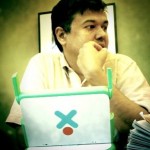
Sameer Verma behind his XO

Sameer Verma with XO

My own journey with OLPC, Sugar and all things related, has been underway for years. I’m a techie at heart, a “thinly-disguised” business school professor, teaching IT strategy and researching business models and consumer behavior. Every once in a while, I’ll sit down and compile a kernel, or run a packet sniffer.  (What can I say? It’s instant gratification and a lot more fun :-)

I think of the tech as the supply side of my interest: The XO makes for a great technology platform. The mesh (whether 802.11s or ad-hoc), suspend with the screen lit, robustness, low power, etc. is all very cool. Cool enough for a grown man to walk around with a funny-looking green machine slung around his shoulder.  The software stack too is amazing, flexible, free. The content is rich. Wikipedia in a box? Awesome! The tech definitely keeps me tethered.

Then there’s the demand side: a part of my family lives in rural India, in Bhagmalpur. A village where I have seen the simple life. Clean air, good food, quiet living. Its also stricken with poverty, sanitation issues, water shortages, and seriously untapped ingenuity.

Maggu at home

Maggu at home

As a kid, I used to hang around Maggu, while he milked a water buffalo, or Bahadur, while he made gold jewelry on a block of coal. Today I wonder what Maggu would do if he could learn about the rest of the world and its dairy achievements. How Bahadur’s family could save the lost art of rural goldsmiths. Would they benefit from a peek into that Wikipedia in a box? You bet. In my mind, I can savor the possibilities of the supply, and imagine what it can do for the demand. I speak with my friend Javier Cardona about IEEE 802.11s, with Maggu on my mind. These worlds must meet.

Finally, there’s the catalyst: my daughter Mira, now age five. She could open the XO, power it on, and turn it around into tablet mode when she was two. At three, she could play Implode on the XO with a finesse that amazed me. Children are like sponges; they soak up everything, and have incredibly simple solutions in their heads.  I cherish Mira’s curiosity and ingenuity, and she has been my catalyst for inspiration.

So that is my supply, my demand, and my catalyst. My story and my guide.

Mira hard at work

Mira hard at work


Every volunteer has her own story. Many come and go, some stay, but all leave a mark on the overall process. They all help us steer projects in new and meaningful ways. For instance, a little over two years ago in Austin the XO manual was written by volunteers to pave the way for a new kind of global user.  Sugar hackers and tech writers of all flavors funded their own way to Austin, to gather and create a resource that is used everywhere today.

A year later, volunteers ganged up in Washington, DC (again on their own dime) to create 30+ OLPC community deployment success stories, compiled into the “Class Acts” repository of tips & tricks.  I’ve dipped into this pool myself, asking my students to convert some of these into one-pagers. If you need a handout for a neighbor or school principal, grab this and print it!

And now we’re preparing for a larger community event, with volunteers from all parts of the movement and from around the world, at the OLPCSF Community Summit. Stay tuned for details and a summit update tomorrow.

Sameer Verma behind his XO

Sameer Verma is the chief organizer of the OLPC SF community. He is also Associate Professor of Information Systems in the College of Business at San Francisco State University.


Comments (1)

Welcome: $35 tablet for education

India’s HRD Minister Kapil Sibal spoke recently of a $35 tablet for Indian students.  In response, Nicholas published this open letter to India.  (Read it also in Hindi, Spanish, French, and German.) Read the rest of this entry »

Comments (60)

India’s tantalizing tablet

As noted here last week, India’s Human Resource Development Minister Sibal announced an interest in distributing a $35 touchscreen tablet to students across India.  Charbax demonstrated the reference design used is likely from AllGo Embedded Systems, which recently displayed a matching ARM device.

While Fast Company, Wired, (and later All Things Considered) have responded  skeptically to the proposed cost, let’s assum that one day we will be able to make such tablets, just as we now have $100 laptops. (I don’t think they are far off – we likewise think we can have a more powerful, rugged tablet for twice that cost by the following year.)  What I want to know is: will the government invest in a national deployment, in providing equal access to rich and poor, and in the connectivity infrastructure needed to make this a truly empowering shift?

Some of the statements made suggest the government are considering a nation-wide 50% subsidy and promotion across over 5,000 schools. That’s a fantastic start — I hope their interest persists long enough to start such a project in earnest.


Update: We would be glad to share any of our tech and experience with an India project to help their vision succeed. Nicholas published an open letter to the Ministry inviting them to Cambridge.

Comments (2)

$20-$40 laptops, in bits and pieces

Humane Reader‘s $20 offline reader : needs only an external display, cables, and keyboard for a 38x25 monochrome display of Wikipedia or whatever text you please. Offered in XO green, it has been designed more as a tool for hackers than a scalable solution for offline reading.  From its own website:

The palm-sized device comes with an SD Card reader for storage and a micro-usb connector for both power and USB device action! The expansion headers break out maximum hackability, and are compatible with most Arduino expansion shields. Use most existing Arduino software, or write from fresh to take full advantage of the audio, video, IR, and keyboard capabilities of the platform.

And there’s talk of a $35 touchscreen tablet : Minister of Human Resource Development Kapil Sibal is personally promoting a reportedly $35 tablet computer, which he says will be available sometime in 2011. Charbax makes the case that he is referring to (and demoing) an AllGo reference design, which was on display in June’s Freescale Tech Forum.  They are still looking for a manufacturer.

Fast Company is extremely skeptical, since India’s last $10 computer was overhyped and misleadingly promoted. It wasn’t a laptop or even an entire computer, it was… hey, wait a minute… it was a cheaper Humane Reader, only done in white and with no industrial design! 

These look like fun, but not something I would necessarily want to use for too long at a stretch. In contrast, I’ve been toting my XO-1.5 HS around all week, and it is very satisfying… more after the jump.
Read the rest of this entry »

Comments (1)

Bikaner LUG members deploy XOs to a school in Rajasthan

A team of Bikaner LUG members rolled out 200 XOs at Kikarwali school two weeks ago, realizing the dream of the India Foundation which sponsored the project. Nitesh Bhardwaj shares details about the 5-day workshop he participated in with members from the local Bikaner Linux User Group (lugb).

This was a single-school independent pilot. It is great to see people writing about field work in India, and working with the strong local Linux communities.

Comments

Sinhala/Tamil XOs in Sri Lanka

OLPC is making great strides into Sri Lanka, as reported recently in the Sri Lanka Daily News. The small island country, just off the southeast tip of India, is looking to turn a corner after years of internal strife, exacerbated by the devastation of the Tsunami in 2004. It is with great pride and anticipation that OLPC is able to join the Education Ministry and University of Colombo in their goals to provide the nation’s younger generation with skills in Information Technology and the English language.


These complimentary aims, reported by the paper as a motivation for the program that will bring 1,250 new laptops to students in thirteen separate schools, have been widely cited as twin engines propelling innovation and progress in Bangalore, not far across the Palk Straight.

1,250 XO laptops are heading to Sri Lanka!

In addition to the operating system in English, the computers are enabled to operate in either Sinhala or Tamil languages. Please check in (or, better yet, leave word) for progress updates coming out of Sri Lanka. We’re very excited about this new venture and can’t wait to hear back.

Comments (2)