Happy New Year! Reflections on OLPC in 2011

As we prepare for 2012, here is a quick look back at the past year of OLPC. We distributed our two millionth laptop (now 2.5M), and our largest programs in Latin America (Peru) and Africa (Rwanda) grew steadily. Austria’s Julieta Rudich and Journeyman Pictures produced a fine documentary about Plan Ceibal in Uruguay (the world’s first complete olpc program), and Peru provided XOs and compatible robotics kits to all of their urban schools.

In East Africa, we expanded our work with African nations and donors to improve education for children across the continent. We were invited by both the African Union and the UN to open an OLPC office in Addis Ababa, Ethiopia. Addis is a major hub for African diplomacy, and the support there for our mission has been stunning. We have become a full partner of the East African Community in Tanzania, and our recent country report on Rwanda has driven further interest in the region.


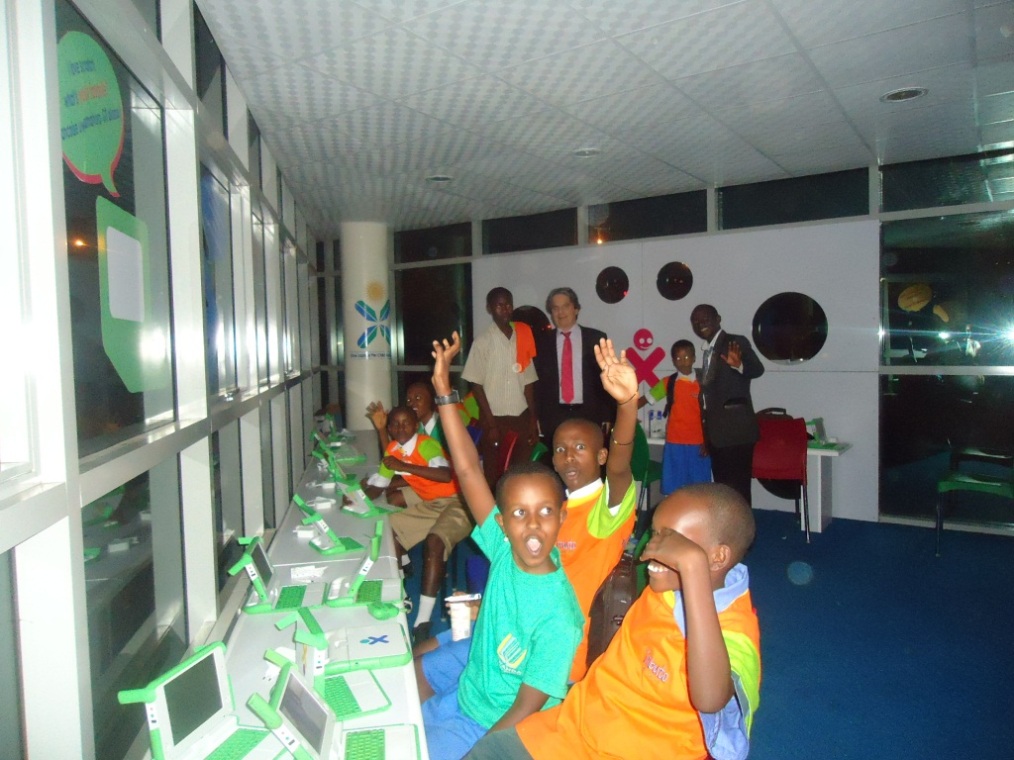
A Rwandan student workshop in Kigali

In the Middle East, we continued working with the Palestinian Authority, Israel and the UN to provide thousands of Palestinian children with XO laptops, integrating them into schools. It took ten months to work the laptops through customs in Gaza. But at a forum in Ramallah in June, teachers from Bethlehem and Gaza showed how OLPC was helping to end isolation and to excite learning for their children. Third grade girls in refugee camps are teaching others and writing computer programs. The testimony of these women to the power of persistence was extraordinary.

In Afghanistan, we founded a regional OLPC Afghanistan office, and briefed General Petraeus on the project. We believe that one laptop per child and connectivity, across the country, will transform this generation and their communities. Today we are working with the Education Ministry to support four thousand children in 10 schools, and are looking into expanding in Herat Province.

On the technical side, we focused on driving down laptop power needs by switching over to ARM chips in the XO-1.75 and upcoming XO-3 tablet. The tablet should be chargable by a solar panel that could serve as its carrying-case. We are studying new ways to help children learn to read, including where there are no schools at all.

In society, the idea that every child should have access to their own computer and to the Web – as a basic part of learning, whatever their family income – continued to spread. In addition to ongoing national programs in Argentina, Portugal, and Venezuela (for secondary students), two full-saturation laptop programs for older students are developing in India – an inexpensive tablet is being distributed to university students, and in Tamil Nadu dual-boot laptops from six different manufacturers are being provided to secondary students.

Reaching the least-developed countries in the world remains our goal and our most difficult challenge. While our largest deployments are funded directly by implementing governments, rural successes may be driven by foundations, NGOs, and individual donations. OLPC Rwanda, today one of the largest educational technology projects in Africa and part of a ten-year government plan, was seeded with ten thousand laptops given by Give One, Get One donors.

So to our supporters: thank you for your development, contributions, and collaboration, your feedback from the field, and your encouragement! This is all possible thanks to you.

Happy New Year to all — may 2012 bring you inspiration and discovery. We have some excellent surprises planned for the new year. And we would love to hear your reflections as well — please share stories from your own school projects in 2011.

Comments (2)

OLPC Rwanda takes off

Update: the OLPC Rwanda 2011 report is out!

OLPC Rwanda (twitter) has grown steadily since its launch a few years ago, and is now part of early education in every school district in the country. Rwanda aims to become a technical and Web powerhouse, and has remained true to that vision. Today they are in some ways the most technically advanced country in the region (to the chagrin of neighboring Kenya, which also hopes to be the hub for software and technology development in East Africa). Rwanda is preparing to double the size of the OLPC project in the country over the coming year, now that they have a smoothly-running system in place.

Happily for us (and for future deployments), the country team has put together a beautiful report on their first three years of work, which will come out tomorrow. It is concise and written for a general audience, with a fine balance of perspectives, from political and financial to the needs of teachers and PTAs.

In related news, Joseph and Erize, the two boys who made their own business cards for their OLPC outreach efforrts in Kigali, saw that we wrote about them on the blog last week, and left comments of their own welcoming questions from all of you. :-)

Comments (1)

Rwandan OLPC mentors: students with business cards

Back in May, we held an international Scratch Day event in our office called “Rwandese Kids Scratching their Communities.” This event had local students familiar with Scratch, an interactive programming activity on the XO laptop, planning and holding their own workshop. They taught teachers, family members and anyone else who came how to create Scratch projects.

This day was open to all and many new children found their way into our offices to learn more about Scratch and the XO laptop. Two such boys were Joseph (grade 3, 10 yrs old) and Erize (grade 2, 11 yrs old).

In the months that followed, Joseph and Erize kept coming to our offices (near
their houses) to use the laptops. During this time, they not only mastered use of the laptop, they spread word to their friends, and now help and guide other children who have begun coming to the office. Their homes have become popular places with family and friends coming each night to learn more and use the laptops.

The boys had been reserved and quiet, but are now outgoing and confident. Their English has expanded from a few sentences to conversational in just a few weeks. It is clear their work with the laptop has empowered them. They are so happy to be involved with OLPC, that they have each created their own business card and tell everyone in the neighborhood that they work for OLPC!

Joseph and Erize, on their own, chronicled through pictures an afternoon of themselves and their families at home with their laptops:


Comments (9)

Rwanda plans international conference on technology in education

OLPC Rwanda has been named to the scientific subcommittee of the International Conference on Technology in Education, organized by the Rwandan Education Ministry and Education Board. The conference will take place in early 2012. Great to hear; let us know when the call for papers is out!

Comments

Lesson development in Rwanda

Julia Reynolds describes some of her work with the Rwandan Education Ministry in developing lesson plans, with a joint workshop and some guest presenters from other educational orgs:

In the old currciulum there was basically a list of subjects, but in the new one there is more description on how the lesson can be carried out through learning-centred methods, information on what the students and teacher should be doing and what are the expected outcomes. They also made sure to relate these concepts to Rwandan life.

Rwanda has been doing a lot of lesson plan work over the past year, I hope some of the results will be available to read online.

Comments

Children talk about OLPC in Rwanda

OLPC Rwanda, which is planning to expand their OLPC deployment to 160,000 children and teachers by next summer, has been talking more about their work and interviewing those currently involved. Africa Online has been running a series on OLPC over the past two weeks, including a recent article on XO use in schools in Kigali.

Comments

Rwanda adds laptop security, gets new XO-1.5s

Rwanda is rolling out a software and firmware update to the students and teachers in their current schools, as they prepare to deploy a new batch of XO-1.5s as they approach their 100K milestone.   Project lead Nkubito Bakuramutsa gave a few interviews about the process, which started two weeks ago in southern Rwanda.

The security update may also give them a chance to reflash their current machines to XOOS 11.2, which has improved solar charging performance and overall power management along with many speed and interface improvements.

The planned expansion of their program will make Rwanda the largest OLPC deployment outside of South America, surpassing even the US and Mexico.

Comments (3)

A trek across Africa to support students

Tamin-Lee Connolly plans to travel from South-to-North across Africa, ending in the middle-east, visiting schools and helping to deploy laptops along the way. She may even bring some of her own. Today she begins her travel by flying back to her native South Africa from Dubai, where she has been working, launching a year-long journey by land rover to visit 39 countries. She plans to volunteer for OLPC and perhaps other educational groups along the way, and has been talking to grassroots XO deployments to find those that would benefit from a visit – starting with the amazing team in Kliptown!

If you’re working in Africa, drop her a line on her travel blog, everything except the horn – perhaps you can meet up during her trek.

Comments

OLPC Rwanda reaches rural schools in Muhanga

Caritas Kanizio of Rwanda’s Education Ministry distributed 500 XOs to students and teachers in Ruli Primary school in Muhanga this week.  This is part of an expansion of Rwanda’s OLPC project to rural schools, which has taken some time to develop but has been in ways the most rewarding part.  It has helped bridge the connectivity and technology divide within the country.

Rwanda has positioned itself as a tech-savvy hub in East Africa for some time, but rural towns have had very limited access to computers.  Parents generally hope to learn about computers through their children, and the program is seen as heralding better Internet connectivity for the communities as well.


Comments (1)

Happy new year

Happy new year to the OLPC community around the world!  Thank you for your part in everything we have accomplished in 2010 – from our new initiatives in Gaza, Argentina, and Nicaragua to expansion of work in Peru, Uruguay, Rwanda, Mexico, Afghanistan, and Haiti.

Special thanks to everyone who has worked on the newest iterations of Sugar, and those who put on the grassroots events over the past year in the Virgin Islands, San Francisco, and Uruguay — all of which has helped connect some of our smaller projects and realize some of their educational dreams in new activities.  We’ve launched our new website for the year, highlighting the stories from these and other deployments; this blog may merge into that site as well (and you can see blog posts appearing in its News section).

Comments

Rwanda on track to deploy 50,000 XOs to 150 schools this year

Nkubito Bakuramutsa, OLPC project coordinator at the Rwandan Education Ministry, talked to the Rwanda New Times this week about the first 10,000 students and teachers who had received laptops through the country’s OLPC program. Rwanda is on track to distribute XOs to 50,000 students by the end of the year, with another 50,000 following soon after.

Laptop preparation in Kigali

Laptop preparation in Kigali

The national deployment team recently finished setting up their software build, and is now flashing 2,000 XOs a day. This is a good milestone for the team — learning how to rebuild all parts of the system on their own is important, and as Zehra can attest the first time you get a NANDBlast production line up and running is memorable.

The schools are including materials from OLPC, Sugar Labs, India’s Azim Premji Foundation, the National Curriculum Development Centre, and the Rwanda Education Commons, with customization help from Microsoft and Rwanda’s Green Hills Academy network of schools.

Comments

Advancing education in Rwanda: two views from Kagugu

East African freelancer Nick Wadhams and Czech journalist Tomas Lindner (from Respekt) both visited Kagugu Primary School in Kigali this month, while in the country covering the recent presidential elections.

Wadhams reported briefly on his visit to Kagugu for a short radio segment for NPR’s All Things Considered.  He gets soundbites from a student and the project coordinator,  and notes some of the worries teachers and parents have.  He finds a classroom dark and dirty, and asks somewhat glibly “do poor kids really need laptops?”

Meanwhile Lindner wrote a subtle review of Rwanda’s development as a technological nation, for the German magazine Tagesspiegel.  He visits Kagugu with this in mind, considering the place of technology in schools as part of Kagame’s national Vision 2020 plan.  He interviews school director Edward Nizeymana, and visits a biology class to see how they learn together with XOs.  They discuss the rapid growth of school attendance, changing motivations and long-term goals of the students, and the challenges teachers face adjusting to new technology and to English as a new language of instruction.  Nizeymana says, responding to questions about whether Rwanda should invest in this way in primary education:

“The critics say that the government should first invest in drinking water or electricity.  But that will not do.  The world is not waiting… we have to run, do many things simultaneously. We can not let modern technologies wait until everyone has clean water at home. “

Read the rest of this entry »

Comments (1)

One Laptop per Child Association settles in Miami

Names can be confusing at times.  Take “One Laptop per Child“: should the per be capitalized?  This was debated long after logos and t-shirts had been designed.  OLPC has included two separate non-profits since its inception:

  • A 501c4 association, originally set up to execute the mission of the project  (Formally:  ONE LAPTOP PER CHILD ASSOCIATION, INC – no acronym, capitalization question avoided via ALL CAPS registration)
  • A 501c3 foundation, originally set up to receive tax-deductible donations to support the mission (Formally:  OLPC Foundation or OLPCF – acronym, just to make things complicated)

At first, most OLPC work was associated with the Association (ha!) and the Foundation dealt only with fundraisers and the like.  Last year, we started dividing effort between the two bodies.  Our projects focused on the poorest countries, remote access, and rebuilding after disasters and conflicts, moved to the Foundation.  Rodrigo Arboleda Halaby, a supporter of OLPC since its inception, was invited to lead the Association, which took more explicit responsibility for long-term support for stable deployments and work in Latin America.  They set up headquarters in Miami, originally with a staff of two.   Now they have a solid team, a new Board, and the first OLPC baby…

This week the Association hosted a coming out party in the South Floriday community, with a debut breakfast for supporters, featuring Samuel Dusengiyumva from the OLPC Rwanda team, who spoke about Rwanda’s plans for the  future.

Read the rest of this entry »

Comments (2)

Sharing the flame of inspiration

This past weekend, we had a country meeting in Cambridge – the sort of gathering of national project leads, and honest sharing of lessons and challenges, that I love best about OLPC.  It ranged from the familiar to the unexpected.  It is fascinating to observe the  with Gaza and Afghanistan providing useful perspectives on what is easy and what is hard in very dense and very sparse regions, under economic and military pressure.

It left me with a lot to think about regarding how we scale passion, awareness, and the practicalities of deployment — we saw a few different successful models for scaling to hundreds of thousands of children and teachers, and discussed social and political pitfalls to avoid.

At the same time, Juliano wrote up a very personal reflection on the recent teacher training sessions he has helped organize in Rwanda.  He comments that last week’s work felt more effective than any he had done so far, but that it made him think about the challenges of scaling training to an entire country.

Read the rest of this entry »

Comments

Rwanda’s broadband is 3rd fastest in Africa

A recent report ranks Rwanda’s broadband connectivity speeds third on the continent, ahead of its neighbors in East Africa.  This seems to be changing rapidly; I recall that just over a year ago, when we hosted the OLPCorps summit in Kigali, it was difficult for attendees to find hotspots to upload videos of any length.

Rwanda keeps on surprising its neighbors.  It intends to be an ICT hub for the region, and is moving in that direction full speed.  Kudos to Kagame and his young crew for making that dream real, year by  year.

Comments

Rwanda: capacity-building for teachers in 150 schools

OLPC Rwanda organized a capacity-building workshop for 300 teachers this week. The school-head and one lead teacher from each of 150 schools attended. The GC4LL blog has a detailed writeup. I like this quote in particular, since passing on the ideas behind our core principles takes time:


They also are going to learn about the two main points of the OLPC implementation: one laptop per each child and children take laptops home. Those two points are always controversial and it is very important that school’s principals understand the underlining logic behind them. It the school management buy the concept, the success chances of the project in the school increase significantly.

There is also a photoset from the event and a copy of their “training booklet“(PDF) online.

Comments

Juliano on Rwanda

The Global Center for Laptops and Learning in Kigali has been updating their blog recently. This past week, Brazil and Rwanda students met via Skype for the first time.

Juliano Bittencourt, who spent a year in Rwanda with his wife, recently posted a lovely email about Rwanda developments to the OLPC Brasil mailing list.

He points to Silvia Kist’s personal blog (in Portuguese) as a source for more information about the work there, along with the ‘laptop learning’ photostream.

Comments (2)

« Previous entries Next Page » Next Page »