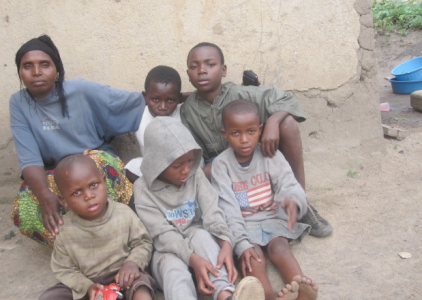
Advancing education in Rwanda: two views from Kagugu

East African freelancer Nick Wadhams and Czech journalist Tomas Lindner (from Respekt) both visited Kagugu Primary School in Kigali this month, while in the country covering the recent presidential elections.

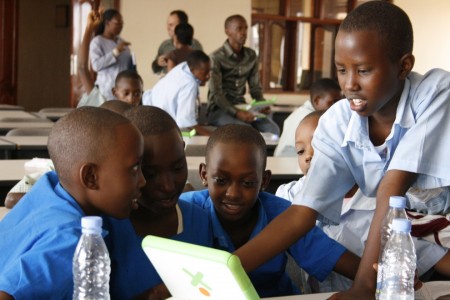
Wadhams reported briefly on his visit to Kagugu for a short radio segment for NPR’s All Things Considered.  He gets soundbites from a student and the project coordinator,  and notes some of the worries teachers and parents have.  He finds a classroom dark and dirty, and asks somewhat glibly “do poor kids really need laptops?”

Meanwhile Lindner wrote a subtle review of Rwanda’s development as a technological nation, for the German magazine Tagesspiegel.  He visits Kagugu with this in mind, considering the place of technology in schools as part of Kagame’s national Vision 2020 plan.  He interviews school director Edward Nizeymana, and visits a biology class to see how they learn together with XOs.  They discuss the rapid growth of school attendance, changing motivations and long-term goals of the students, and the challenges teachers face adjusting to new technology and to English as a new language of instruction.  Nizeymana says, responding to questions about whether Rwanda should invest in this way in primary education:

“The critics say that the government should first invest in drinking water or electricity.  But that will not do.  The world is not waiting… we have to run, do many things simultaneously. We can not let modern technologies wait until everyone has clean water at home. “

Continue reading

Sharing the flame of inspiration

This past weekend, we had a country meeting in Cambridge – the sort of gathering of national project leads, and honest sharing of lessons and challenges, that I love best about OLPC.  It ranged from the familiar to the unexpected.  It is fascinating to observe the  with Gaza and Afghanistan providing useful perspectives on what is easy and what is hard in very dense and very sparse regions, under economic and military pressure.

It left me with a lot to think about regarding how we scale passion, awareness, and the practicalities of deployment — we saw a few different successful models for scaling to hundreds of thousands of children and teachers, and discussed social and political pitfalls to avoid.

At the same time, Juliano wrote up a very personal reflection on the recent teacher training sessions he has helped organize in Rwanda.  He comments that last week’s work felt more effective than any he had done so far, but that it made him think about the challenges of scaling training to an entire country.

Continue reading

Rwanda’s broadband is 3rd fastest in Africa

A recent report ranks Rwanda’s broadband connectivity speeds third on the continent, ahead of its neighbors in East Africa.  This seems to be changing rapidly; I recall that just over a year ago, when we hosted the OLPCorps summit in Kigali, it was difficult for attendees to find hotspots to upload videos of any length.

Rwanda keeps on surprising its neighbors.  It intends to be an ICT hub for the region, and is moving in that direction full speed.  Kudos to Kagame and his young crew for making that dream real, year by  year.

Rwanda: capacity-building for teachers in 150 schools

OLPC Rwanda organized a capacity-building workshop for 300 teachers this week. The school-head and one lead teacher from each of 150 schools attended. The GC4LL blog has a detailed writeup. I like this quote in particular, since passing on the ideas behind our core principles takes time:


They also are going to learn about the two main points of the OLPC implementation: one laptop per each child and children take laptops home. Those two points are always controversial and it is very important that school’s principals understand the underlining logic behind them. It the school management buy the concept, the success chances of the project in the school increase significantly.

There is also a photoset from the event and a copy of their “training booklet“(PDF) online.

Juliano on Rwanda

The Global Center for Laptops and Learning in Kigali has been updating their blog recently. This past week, Brazil and Rwanda students met via Skype for the first time.

Juliano Bittencourt, who spent a year in Rwanda with his wife, recently posted a lovely email about Rwanda developments to the OLPC Brasil mailing list.

He points to Silvia Kist’s personal blog (in Portuguese) as a source for more information about the work there, along with the ‘laptop learning’ photostream.

Stories from Rwanda schools

Julia has posted a half-dozen recent updates to her excellent Rwanda blog, about her work, thoughts on access to knowledge, and efforts with the Kigali Institute of Education. She includes some interesting photos of students showing off their Etoys storybooks and drawings.

She also reminded me of the CMU student group that visited Nonko School last month to run classroom workshops – an interesting model of community service.

How classroom XOs can help Rwanda’s economy

Rwanda aims to complete deployment of their next 100,000 children by next summer. National project coordinator Nkubito Bakuramutsa was interviewed this week for an article in the Irish Times.

They discuss recent successes and policies at the Rwandan schools that have deployed the first batch of XOs in the country. Kagame and the teachers involved are both optimistic that they will transform their society into a leader in technology advances. Kagame aims to triple the nation’s economic output over the next 10 years.

The future of East African education: EAC and EALA input

At the end of last month, we were invited to sign an MOU with the East African Community (EAC) at the East African Community Investment Conference in Kampala. This was the follow-up to last November’s meeting in Arusha, Tanzania for the 10th Anniversary of the East African Community and Legislative Assembly (EALA). Lidet has been organizing this series of meetings, and helped schedule the week around this latest event.

There was a press conference and signing, with Matt, Lidet, Julia and Sam from OLPC Rwanda, the Secretary General of the EAC, the Speaker of the EALA, Ministers from several countries, parliamentarians from five countries, and Uganda’s Ministers of Education and Technology. Coverage of the event was extensive in Uganda, with some international coverage, and press questions were enthusiastic.

The seriousness of the EAC and EALA was striking. So often lip service is paid, promises to follow up are pledged, but at the end of the day, conversations slip away. But both the Speaker and the SG pledged to move quickly, spoke passionately about the future in education for East Africa, and discussed how to work with individual countries and with the EAC collectively. They also publicly stated olpc East Africa (30 million children) as a goal for 2015.

Continue reading

School reports from Kagugu and Rwamagana

Julia recently travelled to Kagugu and Rwamagana to work with the OLPC schools there.

In Rwamagana she ran a week-long workshop, working with the students on programs and storytelling. In Kagugu, she took part in a larger review of the project, and helped them update their XOs with an assist from veteran globetrotter Daniel Drake – exercising the nandblast scripts and gathering data on laptop repairs.

I wonder what Bruce would say about the project today.

2010 Internships open in Rwanda, Paraguay, Peru, Nicaragua

The OLPC Association is pleased to announce new internship opportunities for the coming year.  Country support interns will support an established deployment for 3 to 12 months, in one of four countries: Rwanda, Paraguay, Peru, or Nicaragua.


Learning outside in Peru

Learning outside with an intern teaching assistant in 2009


Support interns serve a vital role in building local capacity of partnering countries and organizations.  Innovators in business, engineering, social sciences, computer science, and public relations will be paired with experts in local knowledge and community building.  Teams will work alongside local school children, teachers, community members, and government officials to accelerate each country toward their long-term goals for education development.   Projects range from technical infrastructure support and local software design to advocacy and classroom assistance.  Internships are open to students over the age of 18.

There are also internship opportunities in grant writing and foundation outreach.  These interns will work remotely, conducting research and working with country deployments to formulate and submit grant proposals.  These are unpaid internships, with possible opportunities to travel to partnering countries.

Apply for an internship online, or find out more about the program.

Continue reading

East African Community OLPC launch

Here’s a short video from last month’s meeting of the East African Legislative Assembly, shortly before the EAC announced a regional OLPC initiative:

This was the 11th Summit of the Heads of State of the East African Community (EAC).  President Jakaya Mrisho Kikwete of the United Republic of Tanzania and Secretary General Juma Volter Mwapachu of the EAC said a few words prior to Matt Keller’s presentation.

The East African Community (EAC) is the regional intergovernmental organization of Kenya, Uganda, Tanzania, Rwanda and Burundi with its headquarters in Arusha, Tanzania.  Its legislative arm, the East African Legislative Assembly (EALA), addresses regional policy issues, and has been active since 2001; Rwanda and Burundi joined the EALA relative recently, in 2007.

East African Community launches OLPC as a regional Initiative

On Friday, November 20, the East African Community launched One Laptop per Child as a regional partner, during the 10th Anniversary Celebration at the Secretariat Office in Arusha, Tanzania.  This annual Summit is the highest organ of the East African Community and it gives general directions and impetus for the development and achievement of the objectives of the Community.

Matt Keller, head of OLPC’s Global Advocacy, made a moving and compelling presentation to the assembled audience and heads of state, including President Jakaya Mrisho Kikwete of Tanzania, President Yoweri Kaguta Museveni of Uganda, President Mwai Kibaki of Kenya, President Paul Kagame of Rwanda, President Pierre Nkurunziza of Burundi, and H.E. Amani Abeid Karume, President of Zanzibar.  The audience included the EAC Council of Ministers, other members of EAC and EALA, and Honorable Speakers.  Invited guests included foreign dignitaries and Chief Executives of regional and international organizations, and members of the European Parliament, United Nations, African Development Bank, and COMESA.

Following Matt’s presentation, Ambassador Juma Mwapachu (current Secretary General of the EAC) announced the launch of OLPC as a regional partner.  A memorandum of Understanding between EAC and OLPC will be signed before the end of the year.  Matt met the six Presidents and gave each of them an XO.  Since our learning team moved to Rwanda to set up a learning center in Kigali, the region has become increasingly important to OLPC.  It was a great honor for Matt and I to attend this historic event, and together with everyone at OLPC we look forward to working with the EAC, EALA and the People of East Africa to bring laptops to children in the region.

New first-time XO users in Rwanda

While Intel may be convinced that netbooks aren’t for first-time computer buyers, a new wave of first-time XO users are paying for part of their own XOs in Rwanda, under their scheme to allow private school students to take part in the government project.  Moses Gahigi interviewed Richard Niyonkuru about the Rwandan national program, and their shift towards a more learner-centered model.

Elsewhere, near Australia, new blogger Air Sok writes about being introduced to Sugar, hosting a guest presenter who had recently been using the XO in East Timor, and using the Physics activity in class.  A lovely post; please stop by and leave a comment on the new blog!

OLPCorps in Rwandan schools, Part 3: EPAK and Kicukiro

This is final part of a 3-part series on the initial learning workshops in Kigali, Rwanda,  focusing on EPAK and Kicukiro schools.

EPAK:
EPAK is located in Kigali. The school has a total of 420 XO laptops, 350 were given by the government; another 70 laptops were given by international humanitarian organization, Right to Play. There are 680 students and 15 teachers. So that each student at the school has access, students in the morning  session will share their laptop with students in the afternoon session. Laptops were first dispersed during the OLPCorps training. 15 OLPCorps members and Paul Commons, Reuben Caron, and David Cavallo of OLPC led the distribution and training sessions.

On day one, the team prepped by discussing a variety of issues which were likely to emerge, such as language barriers, how to address concerns of integrating the laptops into the curriculum, etc.  Teams touched upon each issue individually and designed approaches based on this discussion.  For language, a majority of the translation was led by Kaçandre Bourdelais from Laval University.  However, during the individual training sessions, French speakers were assigned to a separate teacher to manage translation. The training provided mostly individual attention on programs that teachers wished to explore in more depth.  Teachers varied in the activities they explored, from Measure and Scratch to Turtle Art.  Later that afternoon, the same teachers were seen explaining what they had learned to their students and how they’ll have the same opportunity the following week.

Day two began by reflashing and NAND blasting several hundred laptops before distribution–only to find out halfway though that the image file was corrupt.  As a result, the majority of the morning was spent installing the latest build.  By lunch time, however, all EPAK’s classes had laptops.  One particular lesson Corps teams took from this experience was the variety of teaching styles carried out in the classroom.  Some teachers, like P1, preferred more strict, instructional techniques, a few teachers valued individual exploration, and others attempted group work.  Unfortunately, unexpected power issues at the school forced us to stop by late afternoon.

Kicukiro:
Kicukiro Primary School is located in Kigali. There are a total of 3242 students, 44 teachers and 780 laptops. These laptops will be distributed after July holidays, so that each child has access, the Headmaster has decided that each classroom will have 20 laptops per classroom. The headmaster Felix says that “kids left their old schools to come here because they heard we would have laptops.”

OLPCorps students working with teachers at Kicukiro Primary School (Photo courtesy Michael Stein)

Language was the main hurdle here.  More photos and conclusions after the jump.

Continue reading

OLPCorps in Rwandan schools, Part 2: Kagugu and Nonko

This is part two of a post about school sessions during the 30 OLPCorps teams’ two-week training in Kigali, Rwanda with members of the OLPC Center for Laptops & Learning and Rwanda’s RITC/OLPC Core Team.

The workshop brought OLPCorps teams to five Rwandan schools with XO laptops; the following is a brief synopsis of the trainings in two of the schools, Kagugu and Nonko:

Kagugu Primary School:
This is known as the best public school in Rwanda. The school is located in Kigali and has a total of 3020 laptops and 3242 students (P1 students share laptops), and 47 teachers. The school has Internet access. Students do not currently take their laptops home. Julia Reynolds of the OLPC Learning Team, Epimaque TWAGIRIMANA Leader of the Rwanda Core Team, Core Team technical members Basil IRENE MASEVELIO, John-Marie NYIRINKWAYA, and 30 OLPCorps members conducted the training at Kagugu. Both days were focused on teachers.

So all 47 teachers could participate, they were arranged into 3 different groups, each with 2-hour training sessions. The first day, teachers were introduced to Scratch. It was their first time using Scratch because the laptops were just recently reflashed to a newer software build. After a basic introduction, teachers were asked to take a picture of any object or scenery in the school yard, and import this picture into Scratch and tell a story about the picture. The teachers, with the assistance of OLPCorps members, used sound, images and animation to tell their stories. At the end of the session, teachers shared their work with the larger group to supportive applause.

The second day, teachers sat with OLPCorps members in smaller groups and explored ways they could use the XO in the classroom. Both OLPCorps members and teachers were fantastic. Together, they explored ways to use Turtle Art, Memorize and Scratch for lessons. One teacher, who had not previously used the laptop in his class, decided he wanted to start right away and grabbed some OLPCorps members to assist him in his classroom.

Kagugu teacher Simon's students with XOs

Kagugu teacher Simon's students using XOs for outdoor language learning

Continue reading

School Sessions in Rwanda with OLPCorps, Part 1 : Rwamagana B

Mwiriwe from Kigali! This is part 1 of a 3 part series on OLPC Learning Center work with OLPCorps this summer.

part 1 | part 2 | part 3

Things are just slowing down here after the excitement and energy brought by the 30 OLPCorps teams who were in Kigali from June 8-17th for a two-week training–the first action of the OLPC Center for Laptops & Learning.

The workshop brought OLPCorps teams to five Rwandan schools with XO laptops; the following is a brief synopsis of each training:

Kicukiro (Photo courtesy Michael Stein)

Students at Kicukiro Primary School (Photo courtesy Michael Stein)

1. Rwamagana B Primary School:
Rwamagana was the first school to receive XO laptops in Rwanda in 2007. The school is located an hour outside of Kigali and has a total of 750 XO laptops, 822 students (P1 does not have laptops), and 12 teachers. All students take their laptops home. Silvia Kist, of the OLPC Learning Team, along with Bryan Stuart, led training, with the support of 11 OLPCorps and 2 Rwanda Core Team Members.  More details after the jump.

Continue reading