eduJAM! planned in Montevideo, May 5-7

This week a team led by Uruguay’s ceibalJAM! (including Gabriel Eirea, Pablo Flores, Gonzalo Odiard, Fernando Sansberro, and Andrés Ambrois) and including Walter, Adam, Christoph, and David Farning, made progress in organizing an education hacking summit in Montevideo, Uruguay.

The name of the event will be eduJAM! 2011 and will take place from Thu May 5 to Sat May 7. Please include the eduJAM! and ceibalJAM! logos below if blogging or writing about the event.

The main objective of the summit is to strengthen the free educational software developer community, with a focus on Latin America and the Sugar + olpc communities. The event will feature discussions around future directions and strategy, hacking on specific projects, and exchange of experiences among different deployments.  The event is being planned in more detail on the sugarlabs wiki.


Registration is not yet open.  Alongside the eduJAM! a couple of extra activities are being planned to make the most of the attendees gathering for the summit (we already know of people from 10 countries who will be there):

A “Conozco Uruguay Tour” is being organized by members of volunteer group RAP Ceibal and the OLPC community, between Sat April 30 and Thu May 5.

There will also be a Sugar code sprint starting Sunday May 8, right after the summit, expected to continue to Monday May 9 if not beyond!


Sponsors are welcome; Activity Central has already offered to be a sponsor, and the organizers are looking for other sponsors both at the national and international level.  We hope you can join us and are looking forward to your comments and suggestions!

Comments (3)

African Union and OLPC commit to educational transformation work throughout Africa

The African Union [AU] and One Laptop per Child today signed a Memorandum of Understanding in which they commit to provide laptops to primary school students throughout Africa.  Matthew Keller, OLPC’s Vice President of Global Advocacy, and Lidet Tilahun, Vice President of International Outreach, were present for the signing at AU’s Headquarters in Addis Ababa, Ethiopia.

The AU has committed itself to work with OLPC in developing large-scale laptop projects, and to work with OLPC on seeking funding from prospective donors as well as recipient countries for these projects. OLPC and the AU will work together to leverage the advantages of the XO laptop and its award-winning Sugar operating system in transforming primary school education, and to promote strategies for better access to laptops and connectivity.

“OLPC’s partnership with the African Union represents another significant step toward a world in which every child has access to a world-class education, to the world’s body of knowledge, and to each other,” said Keller. “The African Union is dedicating itself not simply to One Laptop per Child, but to a world in which the children become agents of change – making things, teaching each other and their families and affecting the social development of their community.”

Commissioner Jean-Pierre Ezin, the AU Commissioner for Science and Technology, said, “Getting connected laptops filled with dynamic educational content into the hands of children throughout Africa will change the way this generation of children thinks and learns. The AU is eager to realize what could be a profound development as a result of advanced technology in the way learning happens both in and out of school, the way that books are read, and the way that education happens inside a classroom. This is a very ambitious project for which we will have to partner with various people and institutions to mobilize and find the resources required to meet the objective of educational transformation.”

Comments (9)

LEGO WeDo and OLPC Peru: national collaboration

The Government of Peru and LEGO’s Education group have been testing the WeDo toolkit in classrooms with XOs since it was released in 2008. This year they have launched a national program to distribute WeDo kits to roughly 20,000 schools.

LEGO’s Lars Nyengaard writes:

“I am happy to announce that the first major deployment of WeDo for XO will happen in Peru, starting this year. An amazing 20.000 schools will be populated with WeDo. 80.000 teachers will be taught in WeDo and the constructionist approach. More than 1,5 million children will experience WeDo across Peru.

We visited Brazil and Peru to understand the challenges for education in some of the underserved areas. Personally, I will never forget my visits to Brazil, the people I met and the children trying out our WeDo prototypes… we have pursued the original idea of bringing robotics constructonism and WeDo to countries, where the OLPC XO is deployed. I am happy, joyful and invigorated by the decision of the Peruvian government to deploy 92.000 WeDo sets with programming software, activities and teacher training.”

OLPC has been testing many different types of sensors and electronics kits, since the earliest work on Turtle Art with Sensors. The XO has also become a fine dedicated Scratch machine, and WeDo kits are easily enabled from within Scratch (with some handy video tutorials). If you can get your hands on an XO and a WeDo kit, try this with your friends, children, and students.

Comments (2)

Go Grovo!

Grovo.com, a new online training site, is running a campaign to help generation XO around the world.  They are donating $1 for every person who signs up (the service is free) between now until December 31st.  They are also thinking about how to help new XO users learn to use the Internet in different ways.  On January 2, Grovo will announce the results on their blog.

Visit www.grovo.com/olpc to get started, and if you like what they’re doing, help spread the word!  There are a number of cool mentor/tutor projects in the works, and I expect to see a flowering of results and active mentor networks in the coming year.

Here’s some background on Grovo from one of their early case studies.  I can’t wait to see is a series of tutorials like this on how to use, say, the most popular sites in a very different online stting, like Nigeria or Korea (where I have a hard time figuring out the social and procedural norms).

Comments

OLPC in eBay’s spotlight

Thanks to eBay for keeping us in its spotlight this month. OLPC is one of the 3 nonprofits featured in their Giving Works Spotlight on Education. A portion of all proceeds bought or sold through that page will go to OLPC.

And we will again be one of the nonprofits on display at checkout during the second week in August — an invitation for eBay users to donate when checking out with PayPal, which has so far raised roughly $20k.

We are also talking to Causecast about ways to make OLPC more visible as a force for educational change, particularly within the US. If you have a story about an OLPC fundraiser you have participated in or want to share, let us know.

Comments

The impact of laptops in education

By Antonio M. Battro, OLPC’s Chief Education Officer

As stated by the Millennium Goals of the United Nations, it is our duty and responsibility to provide a good education for all children. The purpose is to provide at least elementary schooling to every child in the world by the year 2015.

Education is essentially about universal values of truth, beauty and good. These values are embodied in historical times. We must recognize that today a new artificial environment interacts with our planet: the digital environment. The sad fact is that while many of us live in the digital era, many more are excluded. The digital divide is one of the greatest obstacles to overcome in contemporary education, especially in poor communities.

An isolated school without computers and connectivity to the Internet is incompatible current educational requirements. But of course, technology is not sufficient. Technology may have an impact on education only if constructive dialogue is occurring among teachers, students and their families. Moreover, digital technology should be in the hands of children at an early age for them to learn the new digital language as a second language. And it must be mobile (laptops or netbooks, instead of PCs) because children learn in many kinds of settings, not only in the classroom.

Some economists have tried to measure the educational impact of digital technologies, but they have reported conflicting results (cf. Computers at Home: Educational Hope vs. Teenage Reality, by Randall Stross, New York Times, July 9, 2010). For instance, children using computers at school and at home have attained good computer skills while their grades in mathematics and language declined. The more so if they live in low income households. These results need clarification.

First, it is important to understand that time is needed to produce a cognitive transformation in a student. It is possible that some of the reported failures are biased because academic performance was evaluated too soon. Any evaluation must factor in the time span of an entire cohort, which is the basic unit in education. The time cannot be abridged; it requires the entire development of the young mind, from childhood to adolescence, some 10 years since the child enters first grade when most of the connections of the developing brain are made. Many cognitive capacities may be latent for years before they are expressed. Currently, tests are frequently done in static and conventional cross sections during the school year instead of in longitudinal studies of individual cognitive dynamics.

Second, in the digital era we can use digital tools for assessment (e.g., online monitoring of the student activities) but we still need new methodologies to obtain robust results. In particular, traditional statistical comparisons between experimental and control groups (as reported in the quoted studies) are not possible when the digital divide disappears and the entire population of students and teachers of a region or country has full access to the digital environment at school and at home. In that case, the control groups disappear and all students have been “vaccinated.” We must invent new methods of evaluation for the digital era.

Third, scale creates phenomenon. We need to change from microscopes to telescopes in order to encompass the wide spectrum of natural phenomena at different scales. The same is true in education…

Read the rest of this entry »

Comments (3)

Young brains and computers: facts and myths

A post by new contributor Antonio Battro, OLPC’s Chief Education Officer

Recently, there has been much debate about whether computers, video games and electronic gadgets are helpful or harmful to the cognitive development of children. Some naysayers point to a study that says that multi-tasking degrades cognitive performance. The proponents assert that new digital technologies provide new opportunities for creativity and collaboration. This debate is also being played out in ministries of education, universities and classrooms all around the world. The outcome will have a major impact on the education and development of our children.

New disciplines coming from the neurocognitive sciences are changing our theory and practice of education and shaping the new field of neuroeducation. At the same time, new communication and information technologies are changing the way we teach and learn. Millions of children and teachers of the world are sharing and shaping a new neurocognitive digital environment. This formidable transformation has opened a debate that often mixes facts with myths. One of the most disruptive “neuromyths” is that early introduction of computing can harm the brain development of a young child and cause “attention damage.” Some even argue that computing in schools should be introduced only to older children. These are myths that we must replace with facts.

One of the amazing facts is that first and second languages are processed in the same cortical regions of the brain when the second language is learned early in life. Otherwise, the second language is shifted to different circuits of the cortex. In a sense, when humans use a computer and share the same digital environment they are using a second language, or “digitalese.” Postponing the new linguistic skills needed in a digital world contradicts scientific findings in neurolinguistics.
Read the rest of this entry »

Comments (4)

OLPC in El Salvador

Teachers and assistants at the Universidad Evangélica de El Salvador

Teachers and assistants at the Universidad Evangélica de El Salvador

El Salvador, which began a 400 XO pilot last year, has been in the news again this week.  Their vice-minister of education Erlinda Handal gave an interview about their program “Cerrando la Brecha del Conocimiento” (Closing the Knowledge Gap), and mentioned hoping to expand their olpc project to cover all primary students in the country over the next four years.

“Children being able to take the ‘laptop’ home is something new, expected to amplify the process of learning, and this opens greater opportunities, better prospects for success.”

I hope to see more news from El Salvador, or at least more videos like these, in the future.

Comments (2)

Stories from Rwanda schools

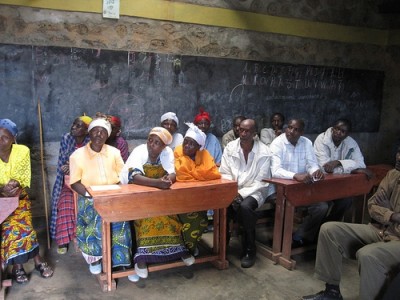
Julia has posted a half-dozen recent updates to her excellent Rwanda blog, about her work, thoughts on access to knowledge, and efforts with the Kigali Institute of Education. She includes some interesting photos of students showing off their Etoys storybooks and drawings.

She also reminded me of the CMU student group that visited Nonko School last month to run classroom workshops – an interesting model of community service.

Comments (1)

OLPC Afghanistan, part 1: forging local partnerships

This is the start of an ongoing series on OLPC in Afghanistan –sj

I travelled to Kabul, Afghanistan last week with two purposes: To assess prospective partners on the ground, including the Ministry of Education (MOE), in order to get a sense of both intent and capacity; and to meet with potential supporters for OLPC in Afghanistan, and craft a strategy for the coming year.

I)  Introduction

Children in Afghanistan

Afghanistan is a hugely complicated part of the world.  Regional politics are impacted by the politics of India, Iran and Pakistan, and the geopolitical wrangling of America, Russia and China add an entirely different element into the mix.  Combine this with decades of virtually uninterrupted war, limited natural resources, and low rural literacy, and you have a country that needs dramatic change in education.

Although relatively rapid progress has been made recently in the education sector, just over half (52%) of primary school aged children are enrolled in school.   Furthermore, due to a shortage of schools and teachers, schools are forced to operate in “shifts”, the average being three “shifts” per day, meaning that each child generally receives only 2.5 hrs (5 x 30min periods) of school each day.  The time constraints imposed by the shift system, combined with the fact that teacher-student ratios are often as high as 1:50-75, result in Afghan children receiving only about half the OECD recommended average time in school. In addition, many teachers in Afghanistan  have an education level only a few years greater than the students they are teaching.  The result is a cycle of rote education, with limited opportunities for innovation.

The conventional remedy of building more schools, training more teachers and providing more materials would require a six fold increase to the education budget (over a billion USD per year), would take 10-15 years to yield measurable results, and would be prey to some of these same problems.

Read the rest of this entry »

Comments (3)

OLPC in the Senate: feedback from today’s event

One Laptop per Child made its public debut on Capitol Hill today with its “Fighting Insurgencies with Laptops” event.

Attendees and speakers, including the ambassadors from Afghanistan and Pakistan to the U.S., painted a picture of an eclectic mix of people from starkly different backgrounds and professions who came together to talk about One Laptop per Child as something that could be a clear manifestation of U.S. smart power. As Senator McCain said, there is nothing better suited to connect and educate this generation of children than OLPC. This refrain was echoed by both the Pakistani and Afghanistan Ambassadors.

Senator McCain speaking about OLPC

Senator McCain speaking about OLPC

This year, we are  expanding our vision by asking Congress to make a concerted push into Afghanistan and the tribal areas of western Pakistan, where isolation and a lack of government reach have spawned some brutal violent extremism.

The OLPC proposal: fight a “soft war” in these areas by giving children access to real education and to the world’s body of knowledge, and by connecting these remote areas to the rest of the planet via computer and satellite.  One child. One laptop. One world.

Comments (14)

« Previous Page « Previous Page Next entries »