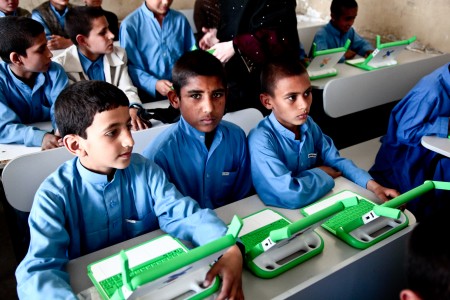
More Than Distribution in Afghanistan

For Afghan kids who receive XOs, their educational time is split between self-study with the laptop at home and sharing their learning experience with teachers and fellow students in the classroom. This blended learning model gives kids sufficient learning time and the support to achieve curriculum.

OLPC Afghanistan laptops are installed with an assortment of materials, including the Ministry of Education’s standard national curriculum of books, health information, and complete localization of all core activities in Dari and Pashto.

And the laptops aren’t just for students. By providing information for parents about economic opportunities, they give parents and kids the chance to learn together.

OLPC in Afghanistan: Briefing Note

Part of an ongoing series on OLPC in Afghanistan.

In their recent publication “Briefing Note – One Laptop Per Child in Afghanistan,” authors Lima Ahmad (AIMS), Kenneth Adams (AIMS), Mike Dawson (PAIWASTOON), and Carol Ruth Silver (MTSA) make one thing very clear: Afghanistan requires an innovative approach to improve their education system.

“The conventional remedy of building more schools, training more teachers and providing more materials would require a six fold increase to the education budget (in the order of $1.8Bn USD per year) and would take 10-15 years to yield measurable results,” the report reads. “While a steady increase in teacher capacity and educational infrastructure is expected over time, Afghanistan does not have the luxury of waiting 15 years to produce the work force foundations for sustainable economic growth.”

Photographed by Jacob Simkin

Instead, the authors say, a more cost-effective, accelerated method lies in using OLPC’s blended learning model, which incorporates technology with teaching. If executed, in 12-18 months OLPC can more than double Afghan students’ time to learning, provide feedback on curriculum materials, and provide resources that the students wouldn’t otherwise have.

By adopting this model, OLPC can “finally give children in both mainstream and community settings sufficient learning time and support to achieve curriculum outcomes.”

Make sure to check out the rest of the report here.

Radio Free XO

Best of Luck to Team One Beep (http://tiny.cc/flay5) next week as they compete in the final international round of the MS Imagine Cup. Their success in transmitting content over FM radio frequencies to an XO is a nice partial solution. Connectivity is a forever problem.

As OLPC continues to develop programs in areas where infrastructure is subject to frequent disruption from natural or man-made causes its use as a communication device is full of possibilities. For the past few months we have been participating in the Global Education Cluster and INEE to position olpc as a solution in the recovery and reconstruction phases of emergencies. Perhaps more significantly olpc has a place in the mitigation and pre-disaster preparation. FM Radio is an effective way to get information and instructions out during emergencies and less likely than Internet service to get knocked-out. XOs plus cheap USB FM radio receivers makes for a great combination for receiving educational content and critical information.

Now if someone can figure out how to make the XO an FM transmitter too…

Updated XO software: “180py”

Bernie Innocenti and the team in Paraguay have released build 180py of their Fedora 11 + Sugar desktop. It is fast, offers both Sugar and Gnome desktops, and includes many recent features from the past year into a build that isn’t too large.

Some call it ‘the best XO OS ever’ – and it is indeed fantastic. Everyone who has an XO-1 should download this build and try it out. (but don’t forget to back up your files and any customized activities first!)

At the same time, Sugar 0.88 is being designed to work on both the XO-1 and the XO-1.5, and is currently available for testing and development. Bernie needs help with finding “a more pronounceable name than F11-0.88” – describing the combination of Sugar 0.88 and stock Fedora 11 – so once more, please share any good naming conventions. If your name is chosen, I will personally ship you one of the near-mythical Red XOs.

Summer Pygames begin again!

The Summer Pygames, sponsored by South Carolina’s Palmetto Project, is growing this year — students from many schools will have six weeks to learn how to make games for the XO, from design and programming to art and sound production.  The results will be judged by elementary school students and teachers.  OLPC has donated some XO-1.5s to the event, which last year produced “Burnie’s Balloons”.  (And check out the video by the Burning Magnetos at the bottom!)
A tip of the hat to Elizabeth Barndollar and everyone who’s helped make Pygames a success two years running.

XO-3 update: OLPC and Marvell partner to design a line of tablets

XO-3 design by Yves Behar
XO-3 taking a photo

This post is now in French on the OLPC France blog – thanks, Lionel!

I’m happy to announce that today we finalized a partnership with Marvell to design a line of education-focused tablet computers. Some of these will be OLPC machines targeted for the developing world, such as the XO-3. The line will be based both on Marvell’s reference design for its Moby tablet and on OLPC’s XO-3 designs (particularly for the low-power end of the line).  (Hat-tip to Charbax for predicting this in March.)

Update: see also this video of Nicholas discussing our current tablet plans. (If you look closely, you can see that some of the highlights were from a talk in the new Media Lab building.)

The first tablets in the line will be based closely on the Moby, ”’not”’ the XO-3, and focused more on children in the developed world. They will be on display at CES 2011 in January, and available next year for under $100. The original XO-3 design is still planned for 2012.  More details after the jump.

Continue reading