Nepal estimates its overall OLPC costs

Rabi Karmacharya runs OLE Nepal, the local team in charge of implementing the current project in Nepal (with 2100 children and teachers at 26 schools).  Today he posted an estimate of the total cost of their XO project — $77 per child per year. This includes network connectivity, school infrastruture, teacher training, repair, content creation, and administrative overhead for the project.

Rabi notes that many of these (connectivity, training, overhead) are fixed costs that go down with scale, and content creation is largely a one-time cost that they benefits all schools.  And this project is still a pilot — less than 0.1% of the country’s primary school-age children.  Other interesting details: their annual repair cost for the first year was just 2.5% – children and families are extremely careful with their laptops; something we have also observed in other Asian countries.

It’s tremendously useful to see this level of detail in shared data and experiences; thanks to the team for publishing it!  They also publish an amazing country coverage map showing every school taking part in the project, with data about each one.

I hope to also see more of this school-level sharing of data and experiences, from environment and power considerations, to usage rates and general feedback, to published creative work of the students!
India’s tantalizing tablet

As noted here last week, India’s Human Resource Development Minister Sibal announced an interest in distributing a $35 touchscreen tablet to students across India.  Charbax demonstrated the reference design used is likely from AllGo Embedded Systems, which recently displayed a matching ARM device.

While Fast Company, Wired, (and later All Things Considered) have responded  skeptically to the proposed cost, let’s assum that one day we will be able to make such tablets, just as we now have $100 laptops. (I don’t think they are far off – we likewise think we can have a more powerful, rugged tablet for twice that cost by the following year.)  What I want to know is: will the government invest in a national deployment, in providing equal access to rich and poor, and in the connectivity infrastructure needed to make this a truly empowering shift?

Some of the statements made suggest the government are considering a nation-wide 50% subsidy and promotion across over 5,000 schools. That’s a fantastic start — I hope their interest persists long enough to start such a project in earnest.

Update: We would be glad to share any of our tech and experience with an India project to help their vision succeed. Nicholas published an open letter to the Ministry inviting them to Cambridge.

The XO-1.5 HS: Hackably Sweet

Part 1 of a limited series

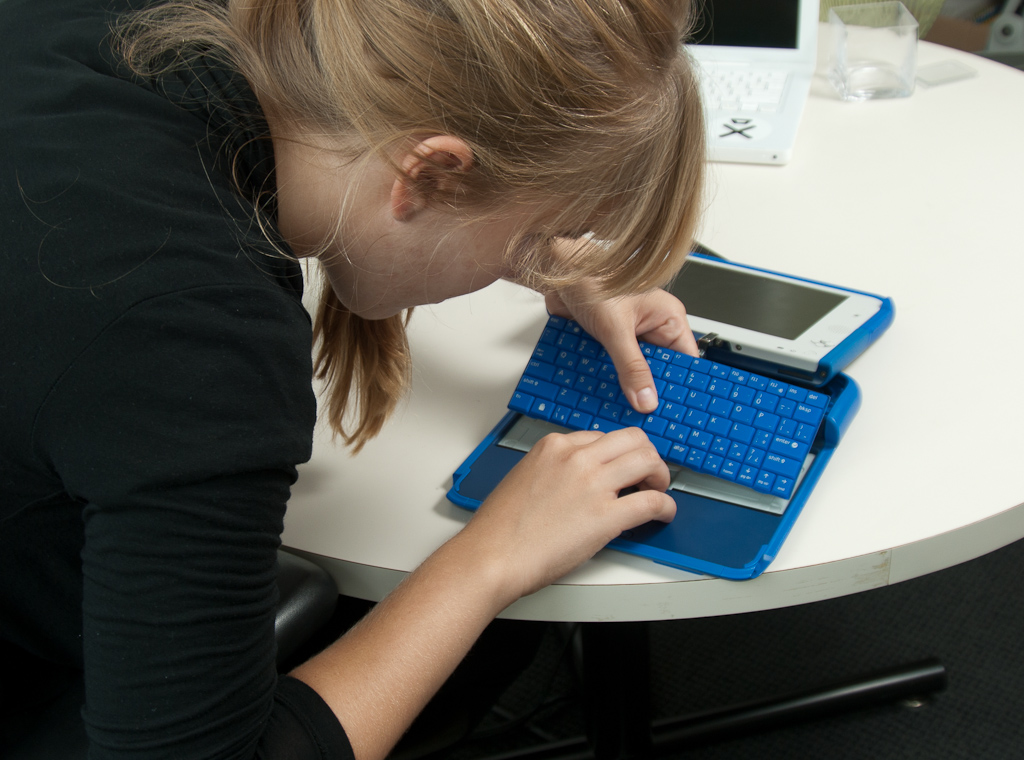
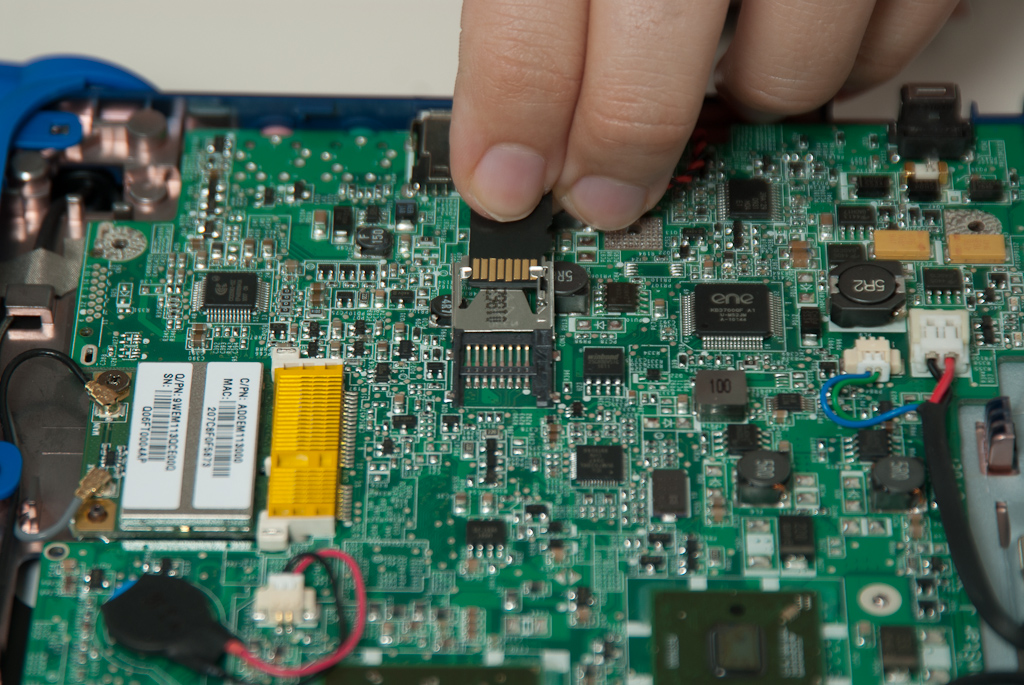
Gillian and I spent part of the day taking apart an XO-1.5 (HS edition!) and putting it back together.  We’ll be showing you how to do everything from a (2-minute!) keyboard replacement to a flash drive upgrade.  Stay tuned for the photo series and guide.

XO-1.5HS Teardown

Gillian removes the new keyboard

Mike upgrades his onboard storage.

Me swapping out the XO-1.5 onboard storage (that's a 4G Micro SD card)

$20-$40 laptops, in bits and pieces

Humane Reader‘s $20 offline reader : needs only an external display, cables, and keyboard for a 38x25 monochrome display of Wikipedia or whatever text you please. Offered in XO green, it has been designed more as a tool for hackers than a scalable solution for offline reading.  From its own website:

The palm-sized device comes with an SD Card reader for storage and a micro-usb connector for both power and USB device action! The expansion headers break out maximum hackability, and are compatible with most Arduino expansion shields. Use most existing Arduino software, or write from fresh to take full advantage of the audio, video, IR, and keyboard capabilities of the platform.

And there’s talk of a $35 touchscreen tablet : Minister of Human Resource Development Kapil Sibal is personally promoting a reportedly $35 tablet computer, which he says will be available sometime in 2011. Charbax makes the case that he is referring to (and demoing) an AllGo reference design, which was on display in June’s Freescale Tech Forum.  They are still looking for a manufacturer.

Fast Company is extremely skeptical, since India’s last $10 computer was overhyped and misleadingly promoted. It wasn’t a laptop or even an entire computer, it was… hey, wait a minute… it was a cheaper Humane Reader, only done in white and with no industrial design! 

These look like fun, but not something I would necessarily want to use for too long at a stretch. In contrast, I’ve been toting my XO-1.5 HS around all week, and it is very satisfying… more after the jump.
Continue reading

OLPC Afghanistan recap

Part of an ongoing series on OLPC in Afghanistan.

Since 2008, we have worked with the Afghan Ministry of Education to build capacity for OLPC in Afghanistan. The initial pilots over the past year have been with 4th-6th grade students, in MOE schools and community-based education groups.

OLPC has committed  5,000 laptops to pilots throughout the country, starting with Esteqlal High School in Nangarhar Province’s Jalalabad city.   There the program engaged all fourth, fifth and sixth grade students, with a ‘3 phase implementation model’ (below) used by the ministry.

The next project involved five schools in Kabul city. Initial feedback has unfortunately only been measured in terms of standardized test results (in math and literacy), but initial results showed a 20% increase on those tests.

In the coming months, national team plans to include schools in other provinces.  They also aim to recruit and train more technical people to help with planning and preparing teachers and connectivity teams for schools across the country.

Parts of this post were drawn from the recent report “Briefing Note – One Laptop Per Child in Afghanistan,” by Lima Ahmad (AIMS), Kenneth Adams (AIMS), Mike Dawson (PAIWASTOON), and Carol Ruth Silver (MTSA)