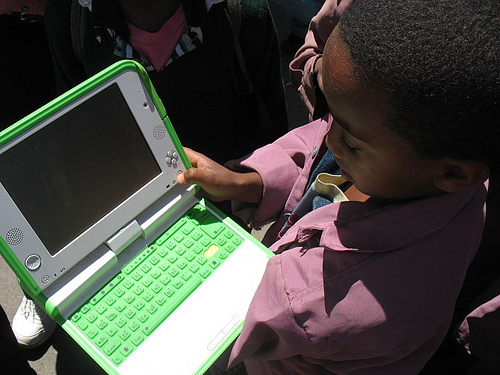
Food Force 2 makes waves

A view of goods available in the market

A view of goods available in the market

Food Force 2, an open source sequel to the World Food Program’s popular Food Force game, is available to try out with complete art and storyboard.   The game leads players through improving the health, shelter, education, and other elements of a small community.

The game has been under development for the XO since our second Game Jam, and gameplay and collaboration are still being worked on.   The latest beta was tested in a school this month at the Delhi Police Public School, facilitated by Vijit Singh.

Congratulations to developers Manu Gupta, Mohit Taneja and Deepank Gupta, and to Silke Buhr who has been the art director and driving force behind the game – it’s looking beautiful.   The team welcomes your suggestions — please download it and give it a spin.

OLPC South Carolina expands laptop program

Last week, Jim Rex, State Superintendent of Education in South Carolina announced that South Carolina would be expanding their One Laptop per Child project. A generous donation from Blue Cross Blue Shield is funding the expansion of South Carolina’s current laptop program.

Blue Cross Blue Shield donation helps expand One Laptop per Child project

An initiative to improve student achievement by making laptop technology available to every elementary school student in the state is expanding this month with the addition of 12 schools.

One Laptop per Child /South Carolina is a partnership between the nonprofit Palmetto Project, Blue Cross Blue Shield and the State Department of Education.  State Superintendent Jim Rex and Steve Skardon of the Palmetto Project accepted a $500,000 donation today from Blue Cross Blue Shield division president and COO David Pankau to help fund the expansion.

The laptop program was piloted last year in rural Marion School District 7.  That rollout has been highly successful, garnering positive response from students, parents and the community.  School officials expect test results at the end of the year to show students are performing better since technology has been integrated into teaching and learning.

To read the latest news about the South Carolina deployment, see their website at http://www.laptopsc.org.

Martin’s Moodle Moot UK 2009

DSC00181

Martin at Moodle Moot '08

Martin Langhoff — our School Server Architect, and long time core Moodle developer reports:

The Moodle UK community just had one of the best MoodleMoots ever. I had the good chance to keynote there, to tell the community about my almost-year away working on XS plumbing, and how it’s now the time to turn the XS into a learning tool.

Social constructivism runs strong in the Moodle community, so when we talk of opening doors to our users’ curiosity, they know first hand about it. And it is a good thing to be able to pierce through the media doom and gloom stories and tell them about the good things that are actually happening on the ground.

The feedback was fantastic, and I am hoping to form a “Moodle-on-XS” test team, and to draw together many very active teachers from the K-12 space to help map out how to make Moodle better for primary schoolers.

You can watch the keynote on video — select the “Moodle and OLPC” video here: http://cardiffschools.net/~tv/cy/moodle.htm

Continue reading

Kicking off a gen-1.5 development process: Updating the XO hardware

XO + Tinkertoys(Box and Tinker) = Directional Cantenna

OLPC is excited to announce that a refresh of the XO-1 laptop is in progress. In our continued effort to maintain a low price point, OLPC is refreshing the hardware to take advantage of the latest component technologies. This refresh (Gen 1.5) is separate from the Gen 2.0 project, and will continue using the same industrial design and batteries as Gen 1. The design goal is to provide an overall update of the system within the same ID and external appearance.

In order to maximize compatibility with existing software, this refresh will continue with an x86 processor, using a chipset from VIA. The memory will be increased to 1 GB of DDR2 SDRAM, and the built-in storage will be 4 GB of NAND Flash with an option for 8 GB (installed at manufacture). The processor will be a VIA C7-M [1], with plans on using one whose clock ranges from 400 MHz (1.5 W) to 1GHz (5 W). The clock may be throttled back automatically if necessary to meet thermal constraints.
Continue reading

President of Uruguay: OLPC bridges the Digital Divide

Dr. Tabaré Vázquez, President of Uruguay, writes glowingly in the Americas Quarterly magazine about Plan CEIBAL, the XO-1 laptop program in Uruguay:

We are implementing the plan one step at a time. To date, we have delivered 151,918 XO computers—low-power laptops that operate with flash memory and a Linux operating system—to students in public schools in Uruguay. By the end of 2009 one laptop will be delivered to each of the 301,143 students and 12,879 teachers in Uruguay’s 2,064 public schools. Students with mental, visual, hearing, or motor disabilities—as well as their schools—will also receive computers specifically tailored to meet their needs.

You can find out more about the Uruguayan OLPC deployment at the Plan CEIBAL website in Spanish or in English.